Par hasard
Life depends on coincidences.
In 1974, I happened to end up in a colleague''s house in the Ardèche, where you enjoyed a truly stunning view of the Eyrieux, which meanders between the mountains. There was still a lot wrong with it, but you''re not just going to tinker with a strange house either. But I thought such a “" "” kind of romantic house would suit me, you can''t sit still for three weeks, right?
I went to a real estate agent, asked for the five cheapest houses - you are and will remain Dutch - and then a fun time begins: looking at houses, because even though photos mean something, on the one hand, they distort and, on the other hand, you really have to see the houses in their surroundings.
Coincidentally, but maybe not, we (wife and I) fell for the cheapest house. Because we didn''t have money, it had to come from the bank. And it had a nice view over a wide valley and the town, ten kilometers away, where the groceries had to be done.
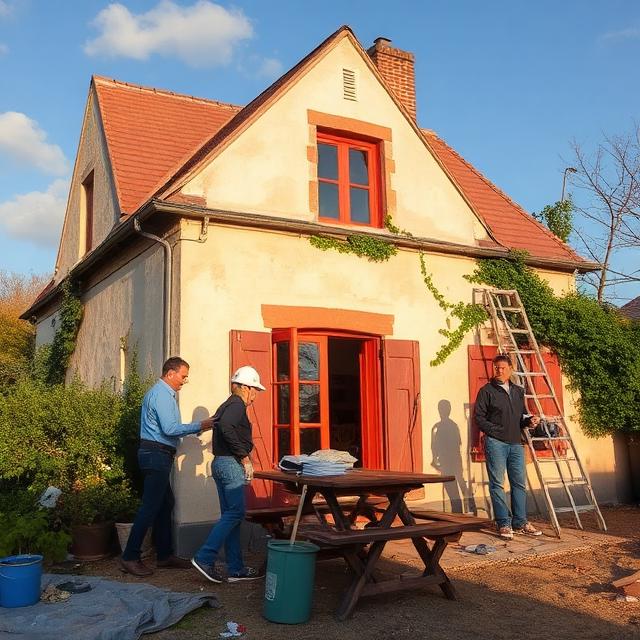
A house at least a century old with no windows, doors, floors, draught on all sides (and later turned out to leak terribly) and walls where cement and clay had been washed out of the joints between the mountain stones.
And yes, then you sit down and sigh and weigh pros and cons. It looks nice, it is very cheap, but really everything still needs to be done about it. Even though you only have five weeks of vacation per year. It''s also far away, eleven hours away and how will things go in the future? The first oil crisis was imminent; the car-free Sunday was coming.
We had already more or less decided not to buy it. Ready. A few days later, we walked through the main street of the village where the house overlooks and a man opens the door of a terraced house; the owner we had spoken to earlier. He invited us over warmly, had coffee, talked and he persuaded us to take another look, and he would come along. And there he deducted almost half of the asking price, and then we definitely couldn''t say no. It was too much to give.
If we hadn''t been walking down that main street by chance, or if that man happened to not have been home... our future vacation life (and that of our children) would have looked very different, with far less hard work...
I sometimes say I bought the house in a fit of bewilderment. Did I know a lot about what I was getting into? And yet: never regretted it for a day. I once heard someone say, “My motto is: life is the plural of guts.” There is something in it, though.
More than thirty years later, I initially bought a small old cottage, made of timber (colombages), in Normandy, but I did not receive a CU (Certificat d'Urbanisme), which is essential to live or stay there, the broker told me. Such a CU did not exist in 1974. I went there again later, it was nicely refurbished and French people lived in it. I don''t trust it completely, but hey.
Searching and searching again and we (sons and I) found a big house with large barns in the countryside of southern Normandy. There are hardly any Dutch people there, who drive on to the Dordogne, where the climate is also more pleasant. In addition to the French, Normandy is mainly populated by English people, who now drive in large numbers via the tunnel under the Channel near Calais. That''s what makes it an attractive region: it''s also close to Brittany, it''s still relatively untouristy and it''s breathtakingly quiet for those who are used to the hustle and bustle of the Riviera
.Once again, the purchased house was a ruin, more or less. There was a lot wrong with it (but yes, very cheap) and after a strong storm, a few of those typical rotten and rusted corrugated sheets blew off the large shed roof (70 square meters). There are always disasters. It rained very hard, though. I removed some more leaking corrugated sheets (a crowbar is very handy) and wanted to replace them with those modern blue galvanized sheets that you see everywhere and that will stay in place for at least fifty years. But it''s impossible to do that alone.
After shopping, I happened to drive back to my minimal village - 300 inhabitants, completely independent with the city council, aldermen and mayor and centered on a church and cemetery (nice for later) - past a picturesque hamlet that I had never noticed before, pulled over my car and walked around the square with about five houses. And there I looked at a roof with the corrugated iron I wanted. If an old man comes out curious, I tell him about my open shed roof and ask where I can find an expert roofer (couvreur). Oh, he knows that, two houses away, and he picks up his neighbor. A broad-shouldered man, broad torso, big belly, curly hair, a mastodon. Would such a man still go up to the roof, and would the roof keep him? But it was indeed a driver, he wanted to help (and earn Black some extra money) but it was noon, dinner time.
At four o''clock in the afternoon, he came by, looked at the roof, we made a price, and next week he would come.
He came — but he couldn''t work for the time being. He had fallen off a pile of wood and had bruises like pancakes the size of pancakes on his arms. No, he hadn''t been to the doctor, it wasn''t so bad, but working: no. Don''t worry, he knew a colleague who might have time. And it came, with his most important tool being a fantastic sixteen-metre-long ladder, which you can simply place on the roof from the ground up to over the ridge. And that''s how we walked up and attached the new corrugated sheets together. And I did do even more jobs with him, although not everything went smoothly. But that''s another story.
But if I hadn''t seen a magical hamlet by chance, if a curious man had not appeared, if I hadn''t been able to speak French enough to explain my problems with the roof, if it weren''t for a coincidence that a retired driver had also lived there, my shed was still under (rain) water today. So the first thing you have to do if you want to start something in France is to learn the language properly. And talking to a lot of people and telling your problems — both are essential.