The sandstone roofs of the Vosges and Haute-Saône
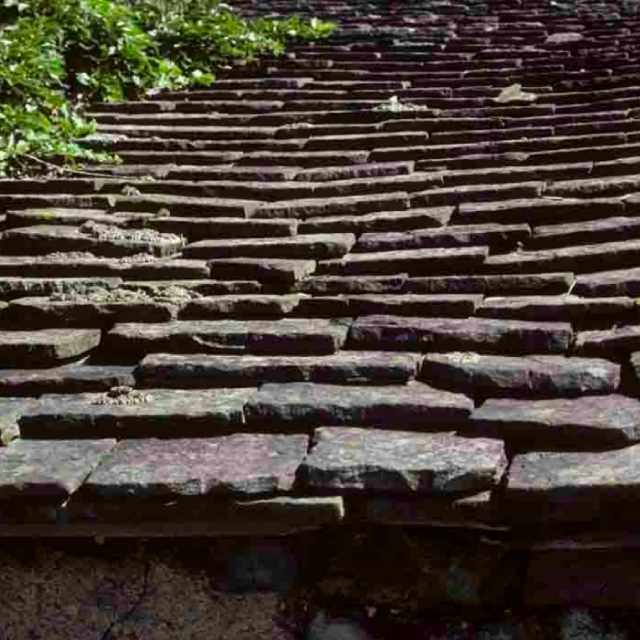
They are piled up in the garden of our French house in the Haute-Saone not far from the southern border of the Vosges department: laves de grès. These heavy, flat sandstone roof tiles are typical of this rural region near the ancient spa town of Plombières-les-Bains; they rest on the roofs of many old houses. With the renovation of our roof in the pipeline - currently still mostly covered with authentic laves - I wonder whether I will (re) use the laves for that or opt for a modern, less laborious roof tile, but then be complicit in the decline of this architectural heritage.
It must be a dilemma for many owners of an authentic French home: do I return my home to its original state as much as possible (a time-consuming and usually expensive renovation), or do I use modern materials so that I can save time and money to enjoy the region during the holidays, and not spend all the scarce free hours doing jobs? The first option undoubtedly provides the best result.
Now, our modest workers'' house is less than a century old and can''t really be called ''authentic'', but the roofing is, which is typical of the region. The laves de grès are only found in about fifty municipalities spread over an area of about forty square kilometers — roughly between Épinal and the Luxeuil-les-Bains spa. For over a century and a half, they have been protecting the roofs of old houses, farms, sawmills, water mills, workers'' cottages and so-called chalots, small farm branches. They give the houses along the dividing line between the eastern French departments of Vosges and Haute-Saône a timeless look, as if they had been petrified over the years and merged like rocks into the hilly country.
The lava still looks most like a large slate that has fallen out and is about 45 centimetres long and twenty centimetres wide. Contrary to what the name suggests, it is not volcanic rock, but sandstone. It was extracted as a by-product in the careers, the quarries where sandstone was mined and cut into blocks for construction. The stately ''Le Prestige Impérial'' in Plombières-les-Bains, for example, was built with sandstone from the area.
Stonemasons
To remove the multicolored sandstone (grès bigarré) hidden deeper in the earth, the stonemasons first had to work their way through the earth and a layer of laves, which was formed about 240 million years ago in a natural process, where the upper layers of sandstone split into slices of a few tens of millimeters. To make necessity a virtue, we looked for a way to use these preformed placards: roofing. Due to the structure, rain or snow has no chance of penetrating the stone, so that the frost can hardly get a grip on it either.
An inventory of the buildings in Ruaux (today incorporated into Plombières-les-Bains) in 1856 shows that all roofs were covered with laves. At that time, each municipality had several quarries that produced laves of different quality and colors. According to local roofers, the shade of color - ranging from gray, white or yellow to wine red - reveals the quality of the stone, but geologists have never found proof of this and the craftsmen themselves are still arguing about which color is the strongest. Unlike, for example, the lave calcaire from Burgundy or the lauze en schiste from the Lozère, the laves de grès were never exported to other regions in France, so this heritage has been limited to a stamp on the French map.
Nailed
While there used to be up to ten different methods of laying the laves — on a layer of soil on a stone vault, in mortar, on wood, nailed or not — today this is limited to the method that requires the least maintenance: nailed to the roof deck. Which just suggests that preserving cultural heritage played hardly a role in determining the construction method at the time - why choose the hard way today?
If properly maintained, the laves should last about 150 to 200 years, but many original lava roofs have declined over time due to lack of maintenance, or replaced with modern roof tiles. Old, mostly abandoned houses and farms, or disused sheds, still have messy lava roofs whose tiles are torn because the water that has drawn in the moss freezes during the harsh winters. But the decay is mainly caused by the rusted nails with which the laves were attached to the roof deck have failed, causing them to slide and eventually fall to pieces on the ground.
Repairing a lava roof is about twice as expensive as laying new roof tiles. Depending on the quality of the laves, the roofer only claims one square meter per hour. Moreover, it is hard work: each layer weighs around five to seven kilos, which also requires thicker trusses than modern variants of roofing. The laves weigh 400 kilos per square meter on the roof deck. An additional problem is that laves are becoming increasingly scarce, because since the Second World War, all the lavières, the quarries, have been abandoned.
For these reasons and others, many homeowners opt for a modern roof and the discarded, still usable laves end up in walls or as patio or garden path tiles, which, by the way, does not produce an unaesthetic result. Finally, the lava also faces a persistent image problem: while a roof with laves is becoming increasingly expensive, the locals still see the laves as building material for the poor. This is how the roofs with laves de grès are slowly but surely disappearing from the landscape.
Dilemma
After presenting my dilemma to a local contractor, he did not recommend renovating my roof with the laves. “It''s possible to do it yourself, but why should you? The house has no typical style and the work takes much longer. You don''t just want to be at work during your vacation, do you?”
His advice is indicative of a mentality that the original roofs around Plombières-les-Bains will never return to. However, there are some bright spots. Small-scale initiatives have taken off in the region that aim to restore the lava. For example, subsidies have been available since 1998 for the renovation of a lava roof. Collaborating municipalities have also joined forces and created a marketplace for trading in second-hand laves. And during the renovation of the Saint Brice chapel in Saint Bresson, the workshop was opened to interested parties who were taught the history and technique of laying laves. These kinds of initiatives hope to stop the decline of the farm, just as the chaumières in the Brière were saved, and the use of de lauze de schiste in Savoy and the laves calcaires in Burgundy has returned. Good initiatives that make me want to give the laves in my garden their place on the roof again - five weeks a year of vacation or not.